

Author: Lexx Che
Author Contact: digital.lexx@gmail.com
Published: 26th Oct 2026
Peer-Reviewed Publication: N/A
Additional References: Literature Publications
Summary: Analysis of Iain Banks's The Wasp Factory, exploring how paternal control of information shapes Frank's identity, body, rituals and the illusion of free choice.
Iain Banks's The Wasp Factory examines how identity takes shape when someone else controls the information through which a person understands their body, history and place in the world. Through Frank Cauldhame's rituals, performed masculinity and prophetic machine, the article explores bodily autonomy, paternal authority, religion and the manufacture of meaning. The wasp's freedom to move within a structure designed to kill it becomes the novel's central problem: how much can choice change when the available paths have already been built?
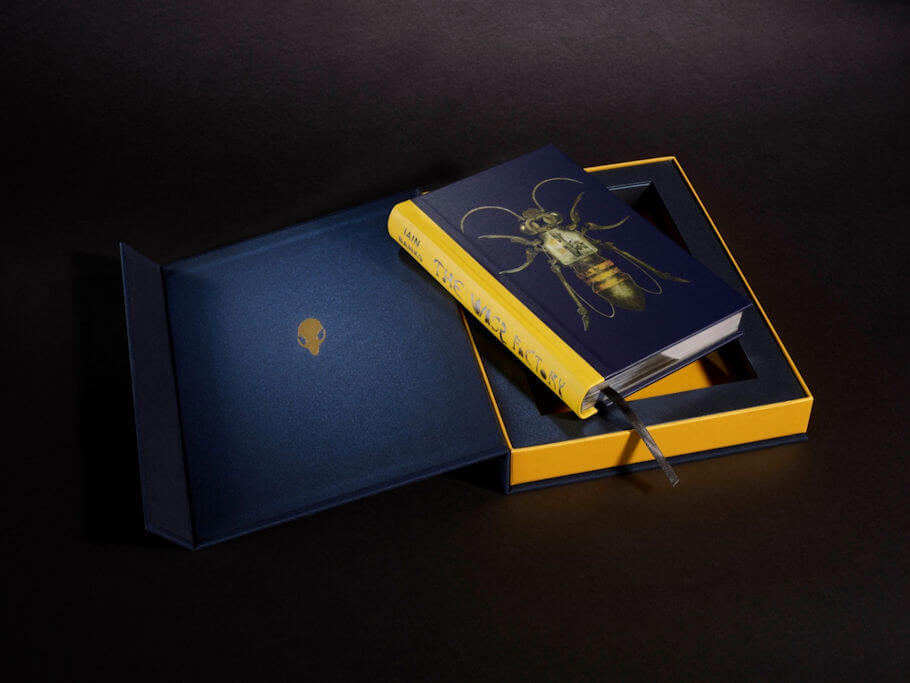 A special edition hardcover of The Wasp Factory by Iain Banks rests partly inside an open presentation box set against a black background. The book has a dark navy cover featuring a detailed illustration of a metallic, mechanical-looking wasp in gold and silver tones, a bright yellow spine with the title and author's name in dark hand-drawn lettering, and a dark ribbon bookmark trailing from the pages. The box is lined in navy fabric with a small gold skull emblem on the inside of the lid, and its edges are trimmed in the same bright yellow as the spine.
This essay contains major spoilers, including the novel's final revelation.
Iain Banks could move from family secrets and black comedy to psychological disintegration, formal experimentation and the organisation of entire civilisations. Under the name Iain M. Banks, he developed the Culture: an interstellar society beyond material scarcity, sustained largely by immensely powerful artificial intelligences called Minds. The distance between that world and the Scottish island of The Wasp Factory seems enormous. Yet both settings accommodate a persistent interest: what becomes possible for an individual within an environment whose fundamental arrangements somebody else has already established?
Published in 1984 after unsuccessful efforts to place his science fiction, The Wasp Factory was Banks's first published novel. Its sharply divided reception made him known before readers had much opportunity to understand his range. The violence was immediately visible; the argument beneath it proved easier to overlook. In the sequence of his published work, Banks would eventually build civilisations. First he built an island, and inside that island, a factory.
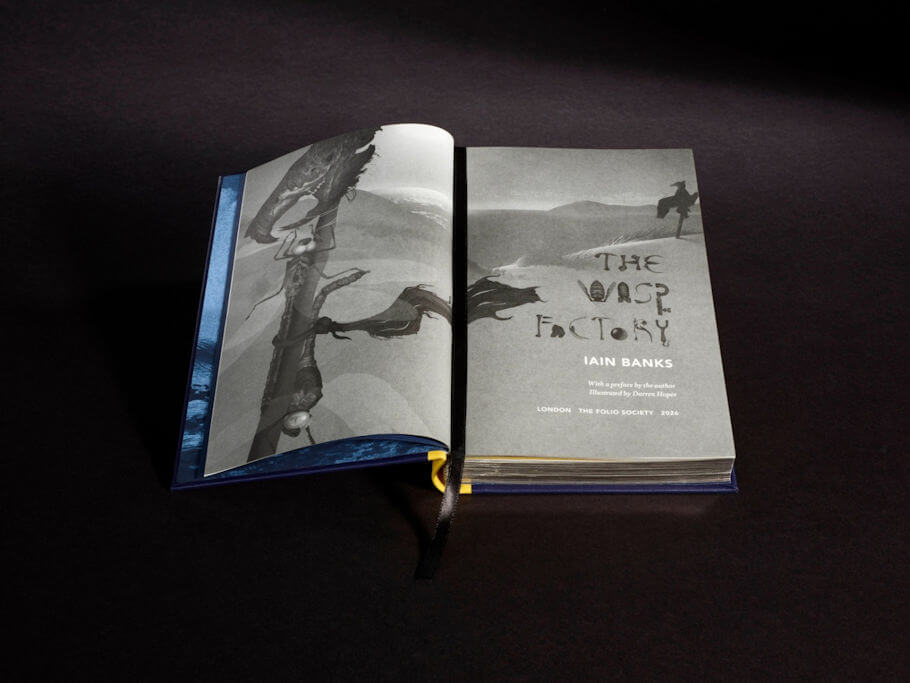 The same book lies open to its title pages on a dark surface, showing grayscale artwork that stretches across both pages. The left page shows a twisted, gnarled post or tree trunk hung with skull-like objects against rolling hills, while the right page continues the landscape with a lone scarecrow-like figure standing on a distant dune. The title is spelled out in quirky letters shaped from odd objects, with the author's name below and smaller text noting a preface by the author, illustrations by Darren Hopes, and publication by The Folio Society in London in 2024; a blue patterned endpaper, a yellow headband, and a black ribbon marker are also visible.
Sixteen-year-old Frank Cauldhame inhabits a territory organised around his own importance. Weapons, patrols, Sacrifice Poles and elaborate rituals make the landscape legible as an extension of himself. Banks told Michael Cobley that the island reflected Frank's separation from society: he was "insular in his perceptions". Crucially, it is a tidal island, connected to the mainland at low water. Its isolation is never absolute. Frank's confinement depends less on impassable geography than on the habits through which he receives, filters and explains whatever crosses its boundaries.
The outside world exists, and Frank has contact with it. What he lacks is reliable access to the information that might overturn his account of himself. His father, Angus, occupies the decisive position between experience and explanation. Frank can distrust particular statements without recognising the scale of the deception holding his life together. Indeed, knowing that a parent sometimes lies can encourage a misleading confidence: the child believes he understands the liar, while continuing to inhabit the liar's most consequential invention.
That invention concerns Frank's body. Raised as a boy, Frank believes a childhood dog attack deprived him of his genitals. The ending reveals that he was born female and that Angus exploited the attack to impose a different history. The intervention is material as well as verbal: Angus has secretly administered male hormones. This is not simply a story about language overpowering anatomy. The father alters bodily development, supplies its explanation and obstructs the possibility of checking either against an independent account.
Frank therefore knows his body through a story whose author has been tampering with the evidence. Bodily sensations remain real; their apparent causes have been arranged for him. The distinction reaches beyond the novel's sexual revelation. We understand bodies through diagnoses, images, measurements, cultural expectations and other people's explanations. Such mediation does not make flesh imaginary or expertise fraudulent. It means that the reliability of an interpretation matters, particularly when whoever supplies it can also control access to the things that might disprove it.
Banks explicitly described his intentions to Paul Tomlinson as "anti-macho, anti-military, anti-religious", adding that the novel was "pro-feminist" and concerned with the nature/nurture debate. He also resisted an explanation based entirely on conditioning. That qualification matters. Angus has not conducted a valid experiment separating biology from upbringing; he has interfered with both. The novel cannot establish their respective proportions. What it exposes is the violence involved when one person claims the authority to determine another's development and then conceals that intervention.
Frank experiences masculinity as something fundamentally his, yet repeatedly needs to demonstrate it. Strength, territorial command, weaponry and contempt for women supply the demonstrations. His supposed mutilation makes these performances especially urgent: he imagines himself excluded from an ordinary masculine future and compensates by becoming sovereign over a smaller world. Masculinity becomes work that cannot be finished. Every defended boundary and defeated creature offers another occasion to establish what the body, as he understands it, seems unable to guarantee.
This does not make violence an inevitable consequence of bodily difference, nor does the revelation excuse Frank's murders. His cruelty belongs to the particular explanations he builds around injury, power and entitlement. Women must occupy a degraded position because femininity threatens the hierarchy through which he assigns himself value. The ending consequently damages more than his account of anatomy. It exposes the dependence of his superiority on a distinction he has misunderstood, without erasing the acts committed in its defence.
The Factory gives this arrangement a physical form. Built around a salvaged clock face and enclosed beneath glass, it offers twelve corridors corresponding to the hours. Frank introduces a living wasp through the centre. Its movements lead towards mechanisms of death, and he interprets the outcome as a prediction. The old instrument for measuring time becomes an instrument for extracting messages about it. Precision survives the conversion: there are routes, triggers and procedures. What disappears is any defensible connection between the apparatus and the knowledge it supposedly produces.
The wasp can choose the path. It cannot choose the system.
Its movement is not wholly dictated. The insect explores, responds and changes direction; this limited agency is essential to the Factory's authority. If Frank simply selected the outcome himself, the procedure would offer less scope for imagining a message from elsewhere. The wasp supplies an event he does not completely control inside conditions he has constructed. Uncertainty at one level helps disguise determination at another. The route remains undecided, while the machine has already excluded a route to safety.
Whether choice amounts to freedom depends here on what choice is allowed to change. The Factory does not abolish movement; it makes movement compatible with an imposed destination. This is a more exact image of constrained agency than a motionless prisoner. Someone can make numerous consequential decisions without possessing the power to revise the conditions under which those decisions occur. Frank's own inventiveness should therefore make us more attentive to his confinement, rather than persuade us that he has escaped it.
The wasp also performs a second function: it converts an occurrence into something Frank can read. A creature's search for passage becomes prophecy because he assigns significance to its destination. Nothing about the death independently establishes the prediction's validity. The physical event and its alleged message belong to different orders, joined by interpretation. The Factory manufactures meaning while presenting the result as a discovery. Frank can then experience his own symbolic arrangements as information received from outside himself.
But the insect's death exceeds that meaning. It is a material consequence, not merely an item in Frank's private vocabulary. To read the wasp only as a symbol would repeat his appropriation of it: a living creature would matter solely because of what it communicates about a human being. Banks's apparatus connects interpretive authority to actual harm. Frank's explanation neither causes the suffering to become necessary nor makes it disappear. The victim bears the cost of a question it cannot understand.
Here the religious structure becomes clear. Frank has sacred objects, territorial observances, sacrifices and an oracle. More disturbing than the absence of evidence is the way evidence appears to be generated. He constructs a procedure, receives its result, then submits to that result as though it carried independent authority. Authorship disappears between construction and belief. The machine's answer can acquire power over the person who made it because he no longer treats its rules as decisions for which he remains responsible.
The comparison with ordinary institutions needs no claim that every classification or model is fraudulent. A rating can measure something real; an algorithm can produce useful results. The danger appears when procedural consistency substitutes for checking assumptions, or when a category gains authority simply because an established system keeps reproducing it. Frank's procedures are elaborate enough to sustain interpretation without correcting it. The Factory's practical workings are consistent; its claim to knowledge remains unsupported. Better workmanship would not make its prophecies more trustworthy.
Angus occupies a parallel position, although his methods wear the costume of experiment rather than divination. Frank arranges conditions for an insect and interprets its behaviour; Angus arranges conditions for a child and claims authority over the result. Their projects differ in intention and scale, but both depend on withholding knowledge from the subject. Frank's command over his miniature world coexists with submission to premises selected by his father. The person who builds the machine is also living inside another machine.
This resemblance does not require Angus to have planned every ritual or crime. His power lies in establishing the conditions from which Frank improvises. The son contributes imagination, labour and decisions that the father need not predict individually. That is what makes the relationship more unsettling than simple obedience. A person may experience considerable independence while supplying the daily effort that keeps an inherited deception alive. Frank defends his identity himself; Angus does not have to stand beside him issuing instructions.
The wasp cannot see the machine from outside. Neither can Frank.
Eric's approaching return introduces something Frank cannot comfortably incorporate into this arrangement. His brother's collapse follows a horrific encounter with a neglected infant while working in a hospital during his medical studies. That history prevents him from functioning merely as a convenient embodiment of madness. Before becoming a source of terror, he encounters an intolerable failure of care. His later cruelty does not cancel that origin, although neither does the origin absolve the cruelty. The institution associated with protection has already failed before he brings destruction home.
Structurally, the brothers offer contrasting responses to experiences they cannot assimilate. Eric's behaviour becomes disruptive and unpredictable; Frank develops procedures that promise containment. This contrast is a reading of the novel's arrangement, not a diagnosis of either character. Frank needs the future to remain interpretable, while Eric's journey keeps producing uncertainty. His return helps precipitate the domestic crisis in which Angus's secret becomes accessible. The danger Frank watches for beyond the island's boundaries arrives alongside the collapse of an explanation maintained inside the house.
The final revelation also exposes a problem in Banks's chosen method. An argument against masculine supremacy is delivered through a bodily discovery that risks making anatomy the ultimate authority after all. The book can therefore be questioned on its own terms: does the ending dismantle an imposed identity, or replace it too readily with another supposedly conclusive description? Its most convincing answer lies in what does not change. Frank retains the memories, actions and responsibilities of the person who existed before the disclosure. New information cannot retrospectively supply a different life.
Nor does the ending authorise a tidy contemporary classification of Frank. The circumstances are dominated by coercion, secrecy and a childhood explanation imposed by a parent. Treating them as a ready-made verdict on present disputes about gender would bypass the novel's particular machinery. Its more difficult question concerns the ownership of self-knowledge: what happens when identity is engineered through control of information, and how does a person begin to distinguish a lived attachment from the conditions under which it was produced?
The reader faces a related disturbance. We have inhabited Frank's account, learning its distinctions and adjusting to its confidence. We may reject his morality while accepting his explanation of the body that supposedly helped produce it. The disclosure overturns his model of himself and the model his narration supplied to us. Coherence has made an account inhabitable without making it true. The unsettling achievement is not simply that Banks withheld a fact, but that so much appeared intelligible while that fact remained unavailable.
Throughout the novel, Frank consults the Factory about what will happen next. His more consequential ignorance concerns what has already been done to him. The wasps die within an arrangement they cannot revise; Frank survives to reconsider an arrangement that finally breaks open. Nothing guarantees what he will make of that opening. What becomes possible, however, is a question his oracle could never answer: how many of his choices belonged to him, and how many became imaginable only because somebody else had designed the space in which he learned to choose?
System Builder and Narrative Architect with nearly 20 years of experience, author, independent journalist, and researcher with Ukrainian roots. His work spans more than 1,000 projects across strategy, design, technology, digital ecosystems, organizational transformation, identity, and decision architecture. He is the developer of the Anti-Coaching methodology and author of the Responsibility series and other books exploring uncertainty, power, communication, and human agency.
His research also extends into independent journalism, with articles published across international media. He is listed as a journalist and author in Muck Rack's global media-intelligence database, while his published work is represented in EBSCOhost's international research and bibliographic infrastructure.
Email: digital.lexx@gmail.com
LinkedIn: https://www.linkedin.com/in/lexx-che/
Projects: https://www.behance.net/deepdgtl
Books:https://www.amazon.com/stores/Lexx-Che/author/B0FV36JBWS
Muck Rack:https://muckrack.com/lexx_che
 Lexx Che
The above information is from our Literature Publications that includes:
The Wasp Factory: Identity Built Inside a Machine - Analysis of Iain Banks's The Wasp Factory, exploring how paternal control of information shapes Frank's identity, body, rituals and the illusion of free choice.
We Do It Too! Sex and Disability Book - 150 personal and professional stories about intimacy and sexuality with a physical disability - #weDoItToo.
Dr. Tatiana’s Sex Advice to all Creation by Olivia Judson– a book review - The Definitive Guide to the Evolutionary Biology of Sex: A delightful opportunity to watch things get weird and wild in the name of science and sex.
Delta of Venus: Erotica by Anais Nin - Book Review - Book review of Delta of Venus, a collection of fifteen erotic short stories.
1Female G-Spot Location with Pictures
How to find the female g-spot.
2Am I Gay? Questions to Ask
Think you may be gay or bisexual?
3Glossary of Sexuality Terms
Definitions of sexual terms & acronyms.
4LGBTQ+ Pride Flags and Symbols
Symbols of Identity and Inclusion.
5Colored Jelly Bracelet Meanings
Meanings of jelly sex bracelet colors.
6Average Penis Size Chart
Information on the human penis size.
• Submissions: Send us your coming events and LGBTQ related news stories.
• (APA): Lexx Che. (2026, October 26). The Wasp Factory: Identity Built Inside a Machine. SexualDiversity.org. Retrieved October 26, 2026 from www.sexualdiversity.org/literature/1224.php
• Permalink: <a href="https://www.sexualdiversity.org/literature/1224.php">The Wasp Factory: Identity Built Inside a Machine</a>