

Author: Lexx Che
Author Contact: digital.lexx@gmail.com
Published: 10th Oct 2026
Peer-Reviewed Publication: N/A
Additional References: Entertainment Publications
Summary: Why H. R. Giger’s Alien still unsettles: an analysis of the biomechanical design language that merged flesh and machine and reshaped genre culture for decades.
H. R. Giger's work on Alien did more than create an iconic creature. By fusing anatomy, machinery, architecture, sexuality and death into a coherent biomechanical grammar, he established a visual system that outlived the film and its creator. The article examines how that system became a generative cultural architecture across cinema, games, album art, tattoo culture, fashion and design.
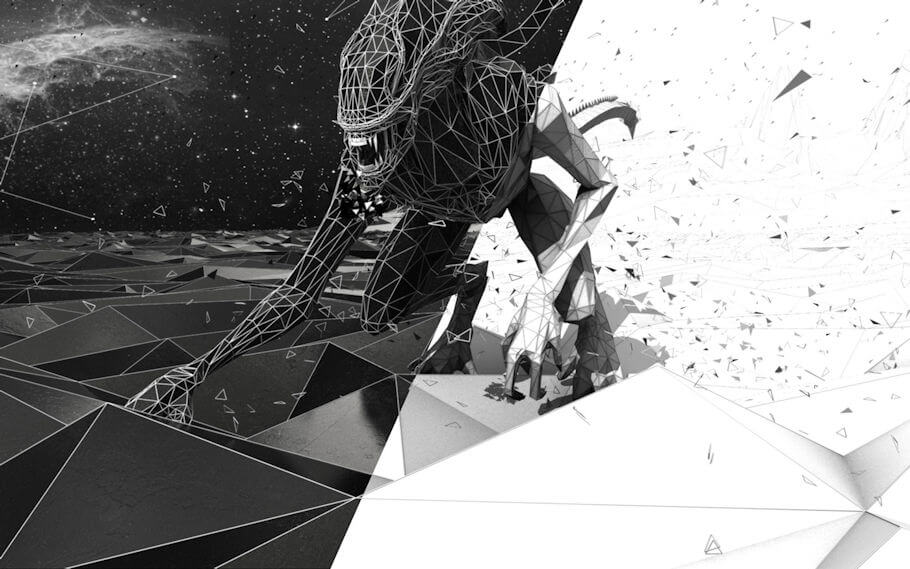 This digital artwork shows the full body of the xenomorph crouched low and moving toward the viewer. Its long skull is tilted down, its toothed mouth is open, and one long arm reaches forward with clawed fingers spread on the ground. Like the first image, the creature is made of low-polygon wireframe triangles. A diagonal line splits the picture in two. On the left the colors are dark: a black, star-filled sky with a faint wispy nebula above a glossy black plain of angular polygon slabs, and the creature’s head and front limbs drawn in white lines on black. On the right the colors flip to bright white: the creature’s back legs and curved tail are pale gray and white, the ground is made of large white angular planes, and scattered dark triangular fragments drift across a white space, as if the scene is breaking apart into pieces. Original art by Deep Digital Co.
Original art by Deep Digital Co
"I had never been so sure of anything in my life."
— Ridley Scott, recalling his reaction to H. R. Giger's work
The most disturbing quality of the Alien appears before the creature has done very much. It seems native to a world that existed before the characters entered it, governed by rules that nobody on screen understands. Science-fiction cinema already had a substantial inventory of extraterrestrials by 1979, along with decades of speculative machines and unfamiliar planets. However strange their appearance, most remained readable according to ordinary categories. Organisms belonged to biology. Equipment had been engineered for a purpose. Architecture contained the action. H. R. Giger's work complicated those distinctions so thoroughly that identifying the function of a form often became difficult. Bone-like structures carried loads. Tubes suggested plumbing while retaining the appearance of internal organs. Mechanical components disappeared into surfaces with the tension and vulnerability of skin.
The xenomorph belongs to this environment so completely that isolating it as a creature design misses part of what made it effective. Its body follows the same visual logic as the derelict spacecraft and the strange apparatus surrounding the Space Jockey. The audience encounters a family of related forms before it has enough information to classify them. Giger had already developed this language in his independent work. Alien gave it scale, movement and an enormous audience. The film did not require him to invent a visual vocabulary from nothing; it provided a place where an existing one could operate across bodies and spaces simultaneously.
Giger called that language biomechanics. The word is useful because it identifies the persistent fusion of anatomy with mechanical construction, although looking at the images reveals something less orderly than the term might suggest. Machinery does not sit cleanly beside flesh. A vertebral structure may perform the visual role of a mechanical support, while cabling carries the tension of tendons or exposed nerves. Reproductive anatomy enters objects whose practical function remains obscure. Surfaces can look manufactured from a distance and disturbingly organic at closer range.
This consistency explains why superficial imitations of Giger are usually recognizable as imitations. The visible inventory is easy to copy. An artist can assemble ribs, tubes, polished darkness and elongated skeletal shapes and arrive at something vaguely Gigeresque. The difficulty lies in making those elements appear to share an internal necessity. In Giger's strongest images, anatomy seems to determine construction. A spinal form does not have to be ornamental if the surrounding object appears to require it structurally. The same principle can extend across an entire room. Once enough components obey that logic, the viewer stops seeing a machine decorated with anatomical references and starts confronting an object whose engineering cannot be separated from its physiology.
The xenomorph's head compresses much of this uncertainty into a form that remains immediately recognizable. Its length and smooth enclosure permit several associations, including armor and animal anatomy, without providing a stable explanation of what the skull actually is. Sexual associations are difficult to avoid, though they do not exhaust the design. More consequential is the absence of visible eyes. Human faces provide information continuously through gaze. We estimate attention and intention from small movements around the eyes, often before a body moves. The Alien clearly perceives its surroundings, yet its face denies the viewer access to that familiar exchange.
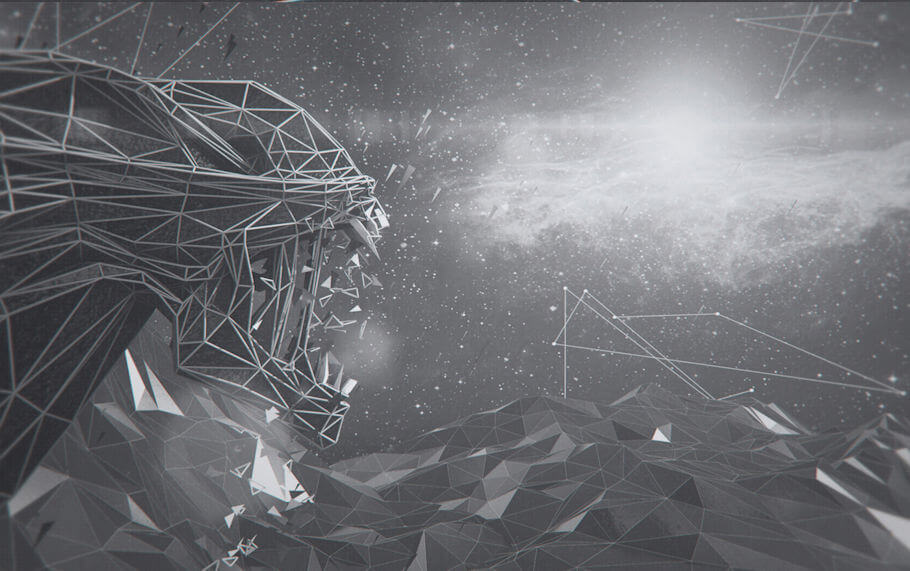 This black-and-white digital artwork shows the head of the xenomorph from Alien in profile on the left side of the frame, facing right. The head is built from a low-polygon wireframe of white lines and gray triangular faces. Its long, curved skull sweeps back off the left edge, and its jaws are wide open. Small triangular shards break away from the mouth and float into the air, so the creature seems to be falling apart into geometric pieces. Beneath it lies a rugged landscape of faceted gray polygons. The sky behind is a dark starfield with a bright, hazy galaxy or nebula glowing in the upper center. Thin straight lines join a few points of light like constellations, one near the top right and another just above the terrain at the lower right. Original art by Deep Digital Co.
Its inner jaw introduces another layer of mechanical behavior. The movement is abrupt and functional, with the directness of a driven component. Little expression is required beforehand. Many screen predators communicate aggression through changes in posture or facial tension that remain legible to human observers. The xenomorph can attack without supplying those signals. Its body performs a function. That relative absence of readable emotion gives the violence an impersonal quality without requiring the creature to behave like a literal machine.
The reproductive cycle places the same design logic inside the human body. A facehugger does not simply injure its victim from outside. It attaches itself closely enough to turn physical intimacy into a source of anxiety. Its limbs enclose the head and its tail secures the contact at the throat. What follows occurs largely beyond sight. An organism is introduced into the host and develops internally while the victim temporarily returns to apparent normality.
The famous chestburster sequence supplies a spectacular release, but much of its force has already been prepared by the earlier loss of bodily control. The host cannot determine what has entered him or what is happening inside his organs. His body has acquired a purpose that does not belong to him. Pregnancy, incubation and birth are recognizable biological processes, yet the film reorganizes their emotional associations through coercion. Giger's imagery was unusually suited to this material because sexual and reproductive references were already embedded throughout his work. The film could draw on that vocabulary without stopping to explain it.
Those references are often explicit enough that treating sexuality as a secondary interpretation makes little sense. Genital structures recur alongside skeletal and mechanical forms throughout Giger's work, sometimes occupying the same shape. What matters visually is the difficulty of deciding when attraction has turned into threat. Smooth surfaces and controlled curves can remain formally beautiful even when their anatomical implications are uncomfortable. Attention may be drawn toward an opening or contour before surrounding details change the way it is read.
A great deal of horror relies on visible damage to establish danger. Giger often works with surfaces that are intact and highly controlled. Repetition gives them an architectural discipline. Mechanical precision can make a disturbing form look strangely finished, even luxurious. The resulting discomfort develops during observation because the formal qualities that invite attention remain present after the subject has become unpleasant. The viewer is given few easy visual instructions for when fascination should end.
Alien carries this uncertainty into its architecture. The derelict spacecraft has obvious technical sophistication, although its spaces do not reveal their purpose through familiar engineering conventions. It looks old without resembling a ruin from any recognizable civilization. Entering it gives the characters physical access while leaving the principles of its construction obscure.
The Space Jockey sequence intensifies the problem. The seated figure connects to its apparatus through forms that make separation difficult. A human observer naturally searches for the edge of the body and the beginning of the equipment because our own machines encourage that distinction. Seats receive bodies; controls receive hands; vehicles contain operators. Giger's construction offers little reason to assume the same relationships. What looks like a chair may participate anatomically in the figure occupying it. Parts that resemble bones may belong equally to the surrounding mechanism.
The uncertainty also affects the perceived age of the place. Science fiction frequently signals the future by extending technologies already familiar to its contemporary audience. Giger's environments resist that dating mechanism. Their advanced qualities are apparent, but their forms do not depend heavily on recognizable consumer technology. The derelict therefore avoids looking simply like an extrapolation of equipment from the late 1970s. Its strangeness comes from the possibility that technology developed there according to premises humans never shared.
That idea has acquired another resonance as everyday technology has changed. Contemporary devices increasingly hide their mechanisms. A phone presents a sheet of glass. Sensors retreat into housings. Software allows complex operations to occur with little physical evidence of the machinery involved. Consumer products are designed to minimize friction and often to suppress awareness of their internal construction.
Giger's machines expose a very different relationship with materiality. They have cavities and articulated internal structures. Their surfaces imply that something might grow beneath them. Connections remain visible enough to suggest circulation or nervous systems. The technology appears vulnerable to processes that normally belong to organisms. It might deteriorate or reproduce. None of this requires the machinery to resemble a contemporary industrial device, which helps explain why the work has aged differently from many period visions of advanced technology.
The larger influence of biomechanics is easier to understand from this perspective. Giger's legacy cannot be measured only by the number of later monsters with elongated skulls or exposed rib structures. Those quotations exist in abundance, but the more consequential inheritance concerns the organization of a designed world. Creature, environment and object can share enough formal logic that each appears to have developed under related conditions. Once that principle is understood, a designer can borrow something from Giger without reproducing his most recognizable surfaces.
During the decades after Alien, biomechanical imagery travelled widely through genre culture. Film and game design repeatedly absorbed organic machinery and environments that seemed grown rather than conventionally assembled. Album artwork provided another natural habitat for the vocabulary, particularly where extreme or experimental music required imagery capable of sustaining discomfort without functioning as straightforward illustration. Tattoo culture adopted the language with particular intensity because biomechanics could interact directly with the anatomy carrying it. A ribbed mechanical structure following an arm or torso gains another level of ambiguity when the viewer can still see the living body beneath the ink. Fashion imagery and commercial visual production have used fragments of the same vocabulary, sometimes with explicit reference to Giger and sometimes after enough stylistic diffusion that the source is barely acknowledged. The original material documents how extensively this visual grammar later circulated across film, games, album art and tattoo culture.
That diffusion has produced an unusual problem of authorship. Millions of people recognize visual ideas derived from Giger without necessarily knowing his name. Alien itself contributed to this separation because the creature became a franchise icon, encountered through sequels, games, merchandise and reproductions far beyond the context in which an audience might notice the production designer responsible for its appearance. Subsequent imitation widened the distance. Once a visual language has circulated for decades, younger designers may encounter its descendants before seeing the work that established the grammar.
This matters when considering why Giger's influence reaches beyond the success of a single film creature. Iconic character design can be copied directly and remain tied to the original silhouette. A visual system is more difficult to contain because its operating principles can survive substantial changes in subject. Remove the xenomorph and the biomechanical logic can still organize a room, a piece of furniture, a helmet or a tattoo. Remove the familiar black surfaces and parts of the same thinking may persist in the relationship between anatomy and structure.
The distinction also clarifies why so many attempts to imitate Giger feel decorative. They reproduce evidence of the system while losing the conditions that connected its parts. Tubes are added because Giger used tubes. Bones appear because his work contains bones. Sexual imagery is inserted because the association is familiar. Such quotations may be immediately identifiable, but recognition alone does not recreate the unease of the original work. Giger's images often withhold the reassuring moment when an object's purpose becomes clear. The viewer continues to search for a classification that the design does not fully provide.
Alien gave this ambiguity a particularly effective cinematic setting. The human characters enter the derelict with instruments and professional routines developed for a comprehensible material world. Those tools allow them to investigate, yet investigation does not make the environment conceptually familiar. The production design permits contact without granting mastery. Later, aboard the Nostromo, the creature carries part of that incomprehensible environment into a human technological space. Its dark surfaces and mechanical anatomy allow it to merge visually with corridors and equipment, which turns Giger's design language into a practical component of suspense.
Familiarity has inevitably altered the creature's effect. The xenomorph is now reproduced so extensively that many viewers know its complete anatomy before watching Alien. Merchandising has converted a once-unfamiliar form into an object that can sit harmlessly on a shelf. Yet the broader design remains resistant to that domestication because its unsettling quality was distributed across relationships rather than located only in the monster's silhouette.
Returning to the film after decades of copies makes those relationships easier to notice. The creature shares assumptions with the spacecraft that preceded it. Its reproductive behavior extends the sexual unease already present in its anatomy. The architecture offers an early encounter with the same difficulty of separating organism from mechanism. These connections do not need a final explanation from the film because their effectiveness depends partly on remaining unresolved. Giger supplied Alien with a coherent visual environment whose internal rules can be sensed long before they can be described, and much of its subsequent influence came from designers continuing to work inside questions that his images had left open.
System Builder and Narrative Architect with nearly 20 years of experience, author, independent journalist, and researcher with Ukrainian roots. His work spans more than 1,000 projects across strategy, design, technology, digital ecosystems, organizational transformation, identity, and decision architecture. He is the developer of the Anti-Coaching methodology and author of the Responsibility series and other books exploring uncertainty, power, communication, and human agency.
His research also extends into independent journalism, with articles published across international media. He is listed as a journalist and author in Muck Rack's global media-intelligence database, while his published work is represented in EBSCOhost's international research and bibliographic infrastructure.
Email: digital.lexx@gmail.com
LinkedIn: https://www.linkedin.com/in/lexx-che/
Projects: https://www.behance.net/deepdgtl
Books:https://www.amazon.com/stores/Lexx-Che/author/B0FV36JBWS
Muck Rack:https://muckrack.com/lexx_che
 Lexx Che
The above information is from our Entertainment Publications that includes:
Inside H. R. Giger's Alien: The Biomechanical Horror That Changed Film, Art and Design - Why H. R. Giger’s Alien still unsettles: an analysis of the biomechanical design language that merged flesh and machine and reshaped genre culture for decades.
Kubrick’s Final Word: Systems, Violence and Eyes Wide Shut - From HAL 9000 to the final word of Eyes Wide Shut, how Kubrick trapped characters in systems they barely understood, and why his last line is so fitting.
Characters Actions in Movie Scripts Reflect Gender Stereotypes - Movies, tv shows, and other media consistently portray traditional gender stereotypes, some of which may be harmful.
Sex Robots: Erotophilia and Sexual Sensation Seeking Good Predictors of Engagement - Study examines the personality traits of people who are more willing to experiment with erobotics or sex robots.
1Female G-Spot Location with Pictures
How to find the female g-spot.
2Am I Gay? Questions to Ask
Think you may be gay or bisexual?
3Glossary of Sexuality Terms
Definitions of sexual terms & acronyms.
4LGBTQ+ Pride Flags and Symbols
Symbols of Identity and Inclusion.
5Colored Jelly Bracelet Meanings
Meanings of jelly sex bracelet colors.
6Average Penis Size Chart
Information on the human penis size.
• Submissions: Send us your coming events and LGBTQ related news stories.
• (APA): Lexx Che. (2026, October 10). Inside H. R. Giger's Alien: The Biomechanical Horror That Changed Film, Art and Design. SexualDiversity.org. Retrieved October 10, 2026 from www.sexualdiversity.org/life/1222.php
• Permalink: <a href="https://www.sexualdiversity.org/life/1222.php">Inside H. R. Giger's Alien: The Biomechanical Horror That Changed Film, Art and Design</a>