

Author: Lexx Che
Author Contact: SexualDiversity.org
Published: 24th Nov 2026
Peer-Reviewed Publication: N/A
Additional References: Sexuality Publications
Summary: Jim Morrison as poet, not poster: The Lords, Horse Latitudes, the 1969 Miami trial, Pamela Courson, Patricia Kennealy and his early 1971 death in Paris.
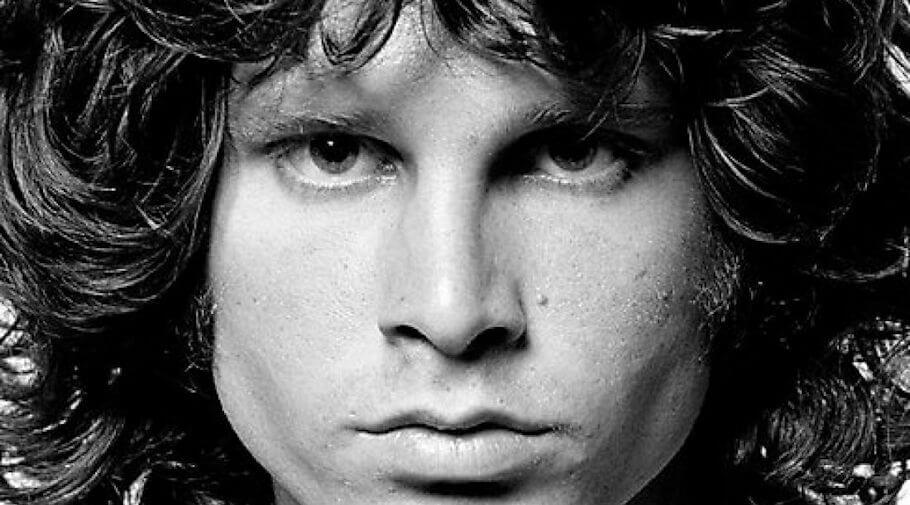 Jim Morrison
"The appeal of cinema lies in the fear of death."
- James Douglas Morrison, The Lords
In the spring of 1969, while Florida was preparing to prosecute Jim Morrison for allegedly showing his penis to several thousand people, a printer in Los Angeles ran off a hundred copies of a book. The name on the cover was James Douglas Morrison, in gold lettering. Anyone looking for the singer of the Doors in The New Creatures would have recognized him soon enough. There was the snakeskin jacket, there was the hair. Elsewhere, the motorists of Los Angeles appeared as "Ghosts in cars," which is about as much as anyone on a California freeway gets to see of the person driving alongside. Morrison needed three words. The question of what a man in the audience had seen of him in Miami would occupy a court for weeks.
An unlined composition book survives from roughly the same period. Jim crossed out words, tried others, drew little things in the margins. Some of the material went into The Lords, his peculiar book about the pleasures of watching. You could do worse than hand that notebook to somebody who took the Lizard King at his word when he announced he could do anything. The boast belonged to a character in "Celebration of the Lizard" who got loose from the poem and followed its author around for the rest of his life. Morrison himself still had afternoons when the best thing he could do with a line was cross it out.
Paul Verlaine had a fairly practical matter in hand when he gave the damned poets their collective name in 1884. Poems circulated among friends, manuscripts went missing, and a Parisian who had heard extraordinary things about Arthur Rimbaud might have considerable difficulty laying hands on a page. Verlaine published a little book of essays about three writers, quoted their poems, and made it possible to read them. Something peculiar has happened to the designation since. A boy with a drinking problem, a beautiful mouth and a plausible prospect of early death can qualify for membership before anybody asks to see what he wrote. Morrison qualified so handsomely that the poems have spent half a century trying to catch up with the photograph.
Rimbaud wanted a long, deliberate derangement of the senses. The deliberation gets considerably less publicity than the derangement.
Listen to "Moonlight Drive," one of the songs Morrison sang to Ray Manzarek on Venice Beach before there was a Doors audience to sing to. A man proposes a swim by moonlight. His voice has the gentle insistence of somebody who has already taken off his shoes and assumes you will follow. On the record, Robby Krieger's slide guitar gives the water a greasy, shifting surface. By the time you understand how far out the man means to go, the shore has disappeared from the song. Try catching the precise instant when the invitation starts to sound dangerous. On a second listen you know the words and still find yourself in over your head.
He could do something considerably uglier with a stretch of calm water. "Horse Latitudes," which Morrison said he wrote in high school, draws on the old maritime story of horses thrown overboard when a ship is becalmed. The sailors barely interest him. His eye goes to the horse at the instant it discovers there is nothing under its feet. What remains in the ear afterward is "mute nostril agony." Nostril is an ungainly word to have to say aloud. It brings the wet muzzle of a drowning animal close enough to touch. On Strange Days the piece lasts less than two minutes, quite long enough to regret having agreed to that swim.
In 1967 Gloria Stavers, editor of the teen magazine 16, photographed Morrison bare-chested in her apartment. He wore one of her necklaces. He still had it on for Joel Brodsky's celebrated Young Lion session, a small continuity between two sittings whose authorship has blurred as the pictures have circulated. Stavers took the image that appeared on the cover of Rolling Stone in 1981, a decade after his death. Brodsky made the arms-out portrait.
What is curious about that portrait is how calmly Morrison offers himself for inspection. A woman could tack the picture to her wall and look her fill. A man could do the same. Neither owed the boy an explanation. At a concert there was a complication to the arrangement. The boy could look back. He could also turn to face the drummer at the very instant the whole room leaned forward.
During "The End," Morrison could keep an audience listening through a passage so quiet that the smallest intervention from John Densmore sounded consequential. The song had begun, he told the journalist Jerry Hopkins, as a farewell, "probably just to a girl." Somewhere in the long evenings of playing it, a son acquired the run of the family house. He went looking for his father and then for his mother. The obscenity that made the piece famous comes very late. What sets the nerves on edge is the time it takes him to walk down the hall. Behind the singer, three working musicians have to keep that hallway open, night after night, long enough for a familiar piece of Greek tragedy to get into an American bedroom.
Pamela Courson had a rather different bedroom to contend with. She and Morrison lived together on and off, and their Laurel Canyon home acquired its own piece of Doors geography in "Love Street." There is a store in the song where, as the singer understands it, mysterious creatures meet. He watches a woman, wonders where she goes, sounds pleasantly like a man who has nowhere in particular to be that afternoon. Courson also had to live with the intervals when he went elsewhere. From the comfortable distance of a record collection, it is easy to hear an enviable freedom in the way his affections wandered. Everybody else involved had a calendar.
Patricia Kennealy could supply a date. In June 1970, according to her account, she and Morrison exchanged vows in a Celtic handfasting. They had met through her work as editor of the music magazine Jazz & Pop. She practiced a pagan religion in which the ceremony carried the force of a marriage, although it gave the couple no civil standing. "It was his idea," she told an interviewer years later. She remembered that Jim understood how much the rite would mean to her.
Kennealy went on to write science fantasy and mystery novels. She knew what a good story sounded like and spent years objecting to what other people had made of hers. Even now, mention the occult ceremony in the same breath as the famous photographs and a mysterious lover with a camera begins to materialize. The necklace belonged to Gloria Stavers, the vows were exchanged with Patricia Kennealy, and when Morrison finally went to Paris, the woman he joined there was Pam.
Something similar has happened with the naked celebrants supposed to have danced in circles around bonfires at Doors concerts. In Miami, Morrison certainly urged people to undress. Witnesses described him coming down off the stage and leading a snake dance through the hall. A lamb turned up onstage, an inconvenient detail for anyone hoping to give the evening the dignity of an ancient rite. There is a recollection of fire, too, from another city and another occasion. In Columbus, Ohio, a concertgoer remembered people setting seats alight after the police stopped the music. The naked circle around a bonfire eludes corroboration. The people in Columbus were furious at having their evening cut short. In Miami several hundred people were briefly willing to follow a drunk who had just climbed down off the stage. The consequences of that evening lasted rather longer.
On March 1, 1969, Miami's Dinner Key Auditorium, a former seaplane hangar, was oversold and desperately hot. Morrison arrived late, had been drinking and kept interrupting the songs. He berated the people who had paid to see him, called them slaves and offered them a look at his penis.
Consider the situation of somebody standing twenty rows back. You can hear the offer perfectly well. A few hundred heads are between you and the man making it. Somebody up front cries out, a neighbor asks what happened, and by the time you get outside you have a story about something you came extraordinarily close to seeing. Some witnesses said they saw it plainly. Morrison denied exposing himself. The photographs offered at trial showed a remarkable variety of things, including the lamb. None settled the question of his penis.
The Miami Herald called him the "King of Orgasmic Rock." Four days after the show a judge signed arrest warrants. Later that month the Orange Bowl hosted a rally for decency, and Richard Nixon congratulated its organizers. A second crowd could now assemble in Miami to declare publicly that its members had nothing in common with the first. Meanwhile, promoters elsewhere were canceling Doors dates. Manzarek, Krieger and Densmore lost work over a gesture none believed their singer had made. Whatever one thinks of Morrison's experiments in crowd behavior, he had found an admirably efficient way of spending somebody else's money.
In 1857 a French court had ordered six poems excised from Baudelaire's Les Fleurs du mal. The judges at least had copies.
In Florida the disputed exhibit had gone back into its trousers, assuming it had ever come out. Witnesses had to reconstruct a few seconds in a hot room more than a year after the event. The jury convicted Morrison of indecent exposure and open profanity in September 1970. He received a six-month jail sentence and remained free pending appeal. Florida granted a posthumous pardon in 2010. By then the man whose conduct the state had undertaken to correct had been dead for thirty-nine years.
While the Miami trial was under way, the Doors played the Isle of Wight. The set was filmed, and the footage would give a director considerable difficulty if the script called for a charismatic shaman. Under a red light Morrison stands at the microphone, bearded, in an embroidered jacket. For long stretches he barely moves. With so little to occupy the eye, you can hear what he is doing with his voice. Oliver Stone understood the photographic Morrison almost too well. In The Doors, his 1991 film, Val Kilmer can turn his face a few degrees and produce the small shock of recognition usually reserved for seeing a dead relative in a living person. Stone gives him a desert vision, naked flesh and enough intimations of doom to keep a lesser prophet occupied for years. The loveliest casting joke belongs to Kennealy. She appears as the priestess conducting the wedding of Patricia Kennealy to Jim Morrison, an eyewitness licensed by Hollywood to pronounce two actors married.
On his twenty-seventh birthday Morrison went into a recording studio to read his poems. There is an ordinary professional vanity in wanting a good recording of your voice, and something touching about choosing to spend a birthday getting one. He had already published two books privately and seen them issued together by Simon & Schuster. He could reasonably expect to write another and to improve on parts of the first.
The papers he left include a plan for a book. Anybody who has kept such a list knows the casual optimism of putting an item down for later. You need only enough paper for another line and the assumption that, eventually, you will have an afternoon.
He went to Paris in March 1971. On July 3 Courson found him dead in the bath of their apartment on rue Beautreillis. He was twenty-seven. No autopsy was performed, and the gap in the medical record has offered decades of employment to people with theories about his last hours. There is a smaller, sadder thing to remember about the apartment. Pam had to get out of that room, speak to another person and begin the business of explaining, in a foreign city, that Jim had died. She lived barely three years longer. She too was twenty-seven.
In the Paris Journal there are nuns at Notre-Dame going from chair to chair with little velvet collection bags. Of all the things an American newly arrived in that cathedral might find to put on paper, Morrison noticed what the bags were made of. You can almost feel the nap of the cloth give under a thumb, hear how softly a coin would land in it. A young man stood amid the splendor of Notre-Dame and got distracted by the practical arrangements for taking up a collection. I would have liked to know what else he might have seen.
Many who first knew Jim Morrison as the sex symbol of their youth remember him now as a remarkable poet whose words have outlived their era, and his grave at Père-Lachaise remains among the most visited in the Paris cemetery he shares with Frédéric Chopin, Oscar Wilde, Édith Piaf, Marcel Proust and Gertrude Stein.
The above information is from our Sexuality Publications that includes:
Jim Morrison, the Last Damned Poet - Sex, Death and the Lizard King - Jim Morrison as poet, not poster: The Lords, Horse Latitudes, the 1969 Miami trial, Pamela Courson, Patricia Kennealy and his early 1971 death in Paris.
The Hidden Cost of Sexual Shame: Why People Struggle to Talk About Desire - Explore how sexual shame silences questions about desire, why privacy differs from shame, and how judgment-free conversations separate difference from disorder.
Marilyn Monroe: The Woman Who Became Sex Itself - Explore how Marilyn Monroe became an enduring sex symbol through Hollywood glamour, iconic performances, sexual imagery, and artistic independence today.
Faith and Internalized Bias Can Hurt LGBTQIA+ Mental Health - A peer-reviewed McGill study finds internalized homophobia and transphobia can cancel out the mental health benefits of religion for LGBTQIA+ people of faith.
• Female G-Spot Location with Pictures
How to find the female g-spot.
• Am I Gay? Questions to Ask
Think you may be gay or bisexual?
• Glossary of Sexuality Terms
Definitions of sexual terms & acronyms.
• LGBTQ+ Pride Flags and Symbols
Symbols of Identity and Inclusion.
• Colored Jelly Bracelet Meanings
Meanings of jelly sex bracelet colors.
• Average Penis Size Chart
Information on the human penis size.
• Submissions: Send us your coming events and LGBTQ related news stories.
• (APA): Lexx Che. (2026, November 24). Jim Morrison, the Last Damned Poet - Sex, Death and the Lizard King. SexualDiversity.org. Retrieved November 24, 2026 from www.sexualdiversity.org/sexuality/1230.php
• Permalink: <a href="https://www.sexualdiversity.org/sexuality/1230.php">Jim Morrison, the Last Damned Poet - Sex, Death and the Lizard King</a>