

Author: Lexx Che
Author Contact: digital.lexx@gmail.com
Published: 6th Nov 2026
Peer-Reviewed Publication: N/A
Additional References: Sexuality Publications
Summary: Explore how Marilyn Monroe became an enduring sex symbol through Hollywood glamour, iconic performances, sexual imagery, and artistic independence today.
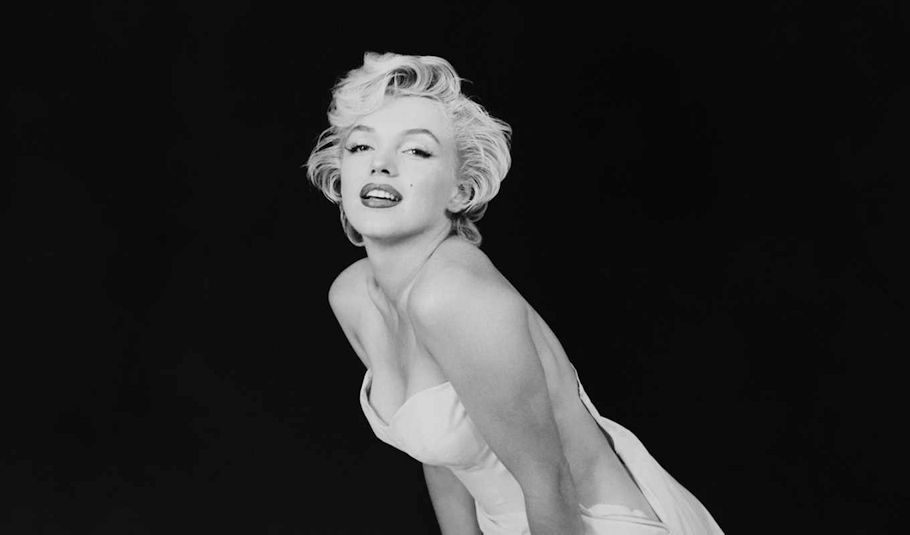 A black-and-white studio photograph of Marilyn Monroe shows her posing against a solid black background, wearing a strapless white dress with a fitted bodice and a softly draped skirt. Her upper body leans forward slightly, with her shoulders drawn back and her head tilted upward as she gazes directly toward the camera with a playful, confident expression. Her lips are slightly parted, revealing her teeth, and her makeup features defined eyebrows, dark eyeliner, and lipstick. Her signature short, platinum-blonde hair is styled in voluminous, soft curls, swept upward and across her forehead. The dramatic contrast between her brightly illuminated face, bare shoulders, and white dress and the dark background draws attention to her elegant pose and glamorous appearance.
Marilyn Monroe - The Ballerina Sitting (1954), Milton H. Greene.
Marilyn Monroe has been dead for more than sixty years, yet her image remains one of the most recognizable representations of female sexuality in modern culture. This is particularly remarkable because the conditions that produced her fame have almost completely disappeared. Contemporary audiences have access to an abundance of explicit sexual imagery, celebrity bodies are displayed across thousands of digital channels, and the moral boundaries that once governed Hollywood publicity have changed beyond recognition. Nevertheless, Monroe remains a reference point against which subsequent generations of actresses, models, musicians, and public figures continue to be compared.
Her longevity cannot be explained by physical attractiveness alone. Hollywood produced numerous beautiful women during the same period, including performers whose careers were longer, whose films were more commercially successful, or whose acting achievements received greater critical recognition. Some became enduring cultural figures. None displaced Monroe from her particular position in the collective imagination. Her sexuality acquired a degree of independence from the films, photographs, and institutions that originally established it.
The essential question is how an actress working within the restrictive Hollywood studio system became a sexual symbol capable of surviving the transformation of sexual culture itself. The answer involves an unusually effective combination of physical presentation, comic performance, institutional manufacturing, public fascination, and the gradual separation of a woman's image from the woman who created it. Monroe was both an active participant in this process and a person whose professional possibilities were restricted by its success.
The transformation of Norma Jeane into Marilyn Monroe took place within a studio system that treated a performer's identity as a commercial property requiring continuous management. Appearance, clothing, publicity, screen roles, and interviews were coordinated to create a recognizable figure whose appeal could be reproduced across films and promotional campaigns. Monroe's platinum-blonde hair, carefully developed makeup, distinctive voice, and highly controlled photographic presentation became components of an increasingly coherent public identity.
The studio did not create her attractiveness, but it developed a commercial language through which that attractiveness could be communicated to millions of people. The difference is fundamental. A beautiful woman could attract attention in a photograph; a successful Hollywood personality needed to produce recognition through changing situations, costumes, expressions, and narratives. Monroe became identifiable through a relatively small number of recurring visual and behavioral characteristics. Her slightly parted lips, lowered eyelids, deliberate movements, breathy speech, and apparent vulnerability formed a vocabulary that audiences learned to recognize almost immediately.
The construction was especially effective because it responded to the contradictions of postwar American culture. Sexual attraction was commercially valuable, yet the open acknowledgment of female sexual desire remained restricted by prevailing moral expectations. Monroe's image negotiated this tension through an unusual combination of sensuality and apparent innocence. Her characters frequently seemed unaware of the effect they produced on surrounding men, even when their appearance and behavior had clearly been organized to provoke precisely that effect.
The resulting sexuality could be displayed openly while remaining protected by comedy. Suggestive clothing, provocative movement, and sexual implication became acceptable because the character appeared playful rather than openly confrontational. Hollywood could sell desire without requiring its audience to abandon the conservative conventions that supposedly prohibited it.
Monroe understood the mechanics of this performance far better than the enduring stereotype of the unintelligent blonde suggests. Her ability to control gesture, expression, timing, and vocal delivery turned a commercially designed persona into something that could not be reproduced simply by placing another attractive actress in the same clothing.
In Gentlemen Prefer Blondes (1953), Monroe's Lorelei Lee inhabits a world in which beauty, money, marriage, and social status are continuously exchanged. The character's interest in wealthy men is presented through comedy, yet the film also exposes the economic circumstances in which female attractiveness functions as a form of capital. Lorelei is frequently treated as foolish by men who assume that her appearance demonstrates intellectual limitations. Her practical understanding of financial security and social transactions repeatedly complicates that assumption.
Monroe's performance depends on maintaining the character's apparent simplicity without eliminating her capacity for calculation. An expression of confusion can conceal an understanding of the situation. A seemingly innocent question can expose another character's intentions. Her comic rhythm allows the audience to recognize meanings that the men within the film overlook. Sexuality becomes part of the character's method of negotiating a social order that already evaluates women primarily through their appearance.
Similar mechanisms operate in How to Marry a Millionaire (1953), where romantic relationships are inseparable from economic expectations. These films emerged from an entertainment industry that frequently reduced female characters to attractive objects, but Monroe's performances gave those objects recognizable preferences, strategies, and contradictions. The resulting characters were neither comprehensive portraits of female independence nor entirely passive constructions of male fantasy.
The distinction becomes even clearer in Some Like It Hot (1959). Sugar Kane is vulnerable, optimistic, sexually attractive, and repeatedly disappointed by men, but the performance requires exceptional control of comic timing and emotional transition. Monroe could move between absurdity and sincerity without making the character appear mechanically assembled from separate characteristics. Her ability to sustain this balance helps explain why the film remains effective long after many of its contemporary references have lost their immediate relevance.
The familiar stereotype of the dumb blonde obscures the sophistication required to perform that stereotype convincingly. Monroe had developed an artistic method in which the audience's assumptions about female beauty became part of the performance itself. The tragedy of her professional position was that the more effectively she demonstrated this ability, the more readily the industry continued to classify her according to the character she was performing.
The controversy surrounding Monroe's nude calendar photographs provides one of the clearest examples of the conflict between sexual visibility and institutional control. The photographs were taken in 1949, before her emergence as a major film star, when financial difficulties made modeling work an immediate economic necessity. Their subsequent identification with Monroe in 1952 threatened the carefully managed public image that Hollywood was developing around her.
The scandal was shaped by an obvious contradiction. Studios were already profiting from the sexual attractiveness of actresses, using carefully composed photographs and provocative roles to generate audience interest. Yet the independent circulation of a nude image could threaten a performer's professional standing because the studio had not controlled the circumstances of its production and distribution.
Monroe responded by acknowledging the photographs and explaining the financial circumstances behind them. Rather than allowing the disclosure to develop entirely through rumor or denial, she made her personal situation part of the public account. The response contributed to a reputation for candor and directness that made the photographs considerably less destructive than the prevailing moral climate might have suggested.
The episode exposed an issue that would become increasingly important in the subsequent history of celebrity culture. A woman's body could possess substantial commercial value without giving that woman corresponding authority over its representation. Sexuality was encouraged when it served an approved commercial purpose and condemned when it circulated beyond established channels. The difference concerned ownership and public interpretation as much as morality.
Monroe's acknowledgment also complicated the distinction between the manufactured actress and the person behind the image. The publicity system preferred a carefully organized account of beauty and glamour. The photographs introduced financial insecurity, employment, and the practical use of physical attractiveness as a means of survival. The sexual image remained intact, but the public could now attach a recognizable human circumstance to it.
The famous subway-grate sequence from The Seven Year Itch (1955) demonstrates how completely Monroe's sexuality could be communicated through a single visual arrangement. Standing over a ventilation grate, she reacts as moving air lifts her white dress. Her attempt to control the fabric becomes part of the spectacle, combining exposure, movement, embarrassment, and amusement within a scene that requires almost no narrative explanation.
The image is frequently remembered as a spontaneous cinematic moment, although its celebrated publicity photographs emerged from a deliberately staged and extensively photographed production event in New York in September 1954. The scene was repeated for cameras, while the original location footage ultimately had to be recreated under more controlled studio conditions. The enduring photograph belongs as much to the history of Hollywood publicity as to the film itself.
Its effectiveness depends on a precise organization of suggestion. The dress conceals the body while threatening to reveal it. Monroe's reaction communicates awareness of the situation without transforming it into explicit sexual confrontation. The viewer's imagination supplies what the image withholds, creating a relationship between anticipation and visibility that can be repeated indefinitely.
This is why the scene has survived independently of the film's narrative. The original comedy concerns male temptation, marriage, fantasy, and the anxiety surrounding sexual opportunity. Those circumstances are unnecessary for recognizing the photograph. Its visual structure is immediately comprehensible even to audiences who have never watched a single Monroe film.
The white dress eventually became an object of imitation in its own right. Fashion photography, advertising, performances, and popular entertainment repeatedly recreated the pose, often using the visual reference as a substitute for any direct explanation of sexual attraction. The gesture became a cultural shorthand capable of functioning without its original performer.
Hollywood had achieved an extraordinary degree of compression. An entire representation of sexuality could now circulate through one frozen movement.
Contemporary sexual culture has radically expanded the visibility of the human body. Explicit photographs, intimate performances, provocative advertising, and sexually suggestive personal branding are available through channels that did not exist during Monroe's lifetime. The scarcity that once increased the commercial value of erotic imagery has largely disappeared.
Monroe's continued relevance suggests that the effectiveness of a sexual image cannot be measured simply by how much of the body it reveals. Her particular appeal developed through the relationship between physical attraction and emotional expression. The camera recorded an actress who could combine deliberate sensuality with hesitation, humor, uncertainty, and apparent spontaneity. These qualities allowed viewers to construct different interpretations of the same gesture.
The sexuality was carefully performed, but its emotional effects were not necessarily experienced as artificial. Monroe possessed an unusual ability to make a constructed image appear momentarily unguarded. Her expressions frequently suggested that the viewer had encountered a private reaction rather than a predetermined public pose, even within highly controlled studio photography.
This capacity made her image adaptable. Different audiences could interpret Monroe as sexually liberated, romantically vulnerable, innocent, calculating, glamorous, or emotionally exposed. Each interpretation emphasized characteristics that were already available within the same public persona. The resulting ambiguity allowed her image to remain culturally functional as attitudes toward female sexuality changed.
Modern imitations demonstrate the limits of purely visual reproduction. Blonde hair, red lipstick, an hourglass silhouette, and familiar poses can recreate the exterior of Marilyn Monroe with considerable accuracy. They cannot automatically reproduce the historical associations, audience expectations, and accumulated meanings that surround the original.
The difference becomes apparent when contemporary celebrities adopt her appearance. The imitation is usually recognized as a reference to Monroe rather than as an independent invention of comparable sexual power. Her image has become a source from which later representations borrow authority.
By the middle of the 1950s, Monroe's commercial success had become a professional constraint. Studios understood her value through a narrow range of characters and promotional possibilities, while her ambitions extended beyond the roles for which she was repeatedly selected. The resulting conflict concerned money, creative authority, and the right to determine the future direction of a career.
In 1954, Monroe established Marilyn Monroe Productions with photographer Milton Greene. The venture represented a significant challenge to the studio arrangements under which performers were expected to accept externally determined roles and contractual conditions. Her subsequent acting studies in New York, including work associated with Lee Strasberg and the Actors Studio, reflected a sustained effort to develop her professional abilities beyond the persona that had made her famous.
Bus Stop (1956) provided an opportunity to demonstrate a more complicated dramatic range. Her character Cherie possesses ambitions and vulnerabilities that cannot be reduced to the glamorous assurance associated with Monroe's earlier screen image. The performance demanded an acknowledgment of insecurity and emotional difficulty without allowing those qualities to become merely decorative.
These decisions are difficult to reconcile with the popular representation of Monroe as a woman entirely controlled by Hollywood. The studio system possessed considerable institutional power, but her career also contains documented attempts to resist its limitations. She sought better contractual terms, greater control over film projects, and recognition of abilities that were often disregarded because of her appearance.
Her professional struggle reveals a paradox within the economics of sexual celebrity. The characteristics that made Monroe exceptionally valuable also encouraged producers to limit her to established commercial functions. Her image attracted investment and public attention, yet the same image could be used to justify refusing her greater artistic authority.
Monroe's difficulties with insomnia, anxiety, and prescription medication have become central to the mythology surrounding her death. Professional problems, including repeated lateness and disruption of production schedules, were also documented by colleagues and directors. These circumstances created genuine conflicts that cannot be dismissed merely because their acknowledgment complicates a sympathetic interpretation of her life.
However, treating the difference between Marilyn Monroe and Norma Jeane as a simple opposition between an artificial public character and an authentic suffering woman introduces another distortion. The available evidence does not establish that every aspect of the sexual persona was imposed against her will or that her private identity can be reconstructed through a small number of traumatic biographical details.
Monroe participated in creating the image that represented her. She understood its professional uses, developed recognizable techniques of performance, and attempted to expand the opportunities that its success had made available. Her personal difficulties existed alongside this agency rather than cancelling it.
The more revealing problem was the public expectation that the image should remain emotionally consistent. A sexual symbol designed to communicate pleasure, beauty, availability, and lightness could not easily accommodate the ordinary instability of human experience. Exhaustion, anger, professional ambition, insecurity, and illness were difficult to reconcile with the permanently inviting personality audiences expected to encounter.
The public was fascinated by the discrepancy, and that fascination intensified after her death. Biographical accounts frequently reconstructed her life as an inevitable movement toward tragedy, selecting events that supported the final outcome while diminishing evidence of humor, determination, professional calculation, and artistic achievement.
The resulting tragic Marilyn became another constructed identity, no less selective than the glamorous version it claimed to expose.
Monroe died on August 5, 1962, at the age of thirty-six. Her death was officially classified as a probable suicide involving barbiturate poisoning. Decades of speculation subsequently produced alternative explanations involving accidental overdose, political connections, and alleged conspiracies, without establishing credible evidence sufficient to overturn the official conclusion.
The persistence of these theories demonstrates the difficulty of accepting an ordinary human explanation for a figure whose public identity had become so heavily invested with symbolic meaning. Her death seemed to require a narrative proportionate to her fame, and successive interpretations supplied increasingly elaborate possibilities.
Within months, Andy Warhol produced Marilyn Diptych, transforming a publicity photograph associated with Niagara (1953) into a repeated visual pattern. Monroe's face appeared in variations of vivid color and fading monochrome, exposing the mechanical reproduction through which celebrity imagery becomes familiar and eventually detached from its original subject.
Warhol's intervention made an existing transformation visible. Monroe no longer needed to act, speak, or appear before a camera. Her face could circulate as an autonomous cultural object, available for artistic interpretation, commercial reproduction, and entirely new associations.
In 2022, Warhol's Shot Sage Blue Marilyn sold for approximately $195 million at Christie's, illustrating the extraordinary economic life that the image had acquired beyond Monroe's films and personal history.
Her death also prevented the gradual transformation of her public appearance through age. The familiar photographs preserved a woman in early and middle adulthood, while the absence of subsequent performances left later generations without the ordinary visual evidence through which celebrity identities evolve. Marilyn Monroe would remain permanently associated with youth, glamour, and the particular sexual vocabulary developed during the 1950s.
The woman was gone. Her image had become infinitely reproducible.
The sexual revolution, the changing position of women in public life, the expansion of pornography, the commercialization of erotic entertainment, and the emergence of digital celebrity have all transformed the conditions under which sexual attractiveness is represented. Monroe's continued recognizability across these changes distinguishes her from an ordinary historical example of changing beauty standards.
Her significance is not that contemporary sexuality continues to follow the moral conventions of the 1950s. It is that the mechanisms through which audiences respond to sexual representation remain more complicated than physical exposure. Anticipation, personality, ambiguity, familiarity, emotional projection, and cultural association continue to influence how attractiveness becomes desirable.
Monroe's image accumulated additional meanings as it traveled through these transformations. The actress became an emblem of Hollywood glamour, then a figure in debates about gender and commercial exploitation, then a recurring subject of feminist reinterpretation, fashion quotation, artistic appropriation, and historical nostalgia. Her sexuality remained recognizable while the explanations attached to it changed.
This accumulation helped preserve the image, although it also increased the distance between the historical woman and the figure reproduced in popular culture. Monroe can now appear in a commercial campaign without any reference to her films, professional struggles, or the circumstances of her life. The familiar face is sufficient to communicate an established collection of associations.
The commercial system that originally manufactured Marilyn Monroe no longer exists in its classical form. The cultural object it helped produce remains active.
Monroe's lasting importance lies in the concentration of several processes within a single public identity: the industrial construction of attractiveness, the professional performance of sexuality, the economic exploitation of celebrity, the struggle for artistic independence, and the transformation of a human image into a self-sustaining cultural symbol.
She became one of the most recognizable women in history while remaining persistently misunderstood through the very image that made her recognizable. Sexual attraction gave her extraordinary cultural power without guaranteeing equivalent control over the institutions that profited from it. Her performances demonstrated artistic intelligence while encouraging audiences to mistake the characters she played for the person performing them.
Marilyn Monroe remains a sex symbol because her image acquired meanings that survived the disappearance of the society that originally produced it. Her beauty made the transformation possible, her performances made it distinctive, and decades of reproduction made it permanent.
Hollywood created Marilyn Monroe as a desirable woman. The world continued reproducing her long after the woman herself could no longer participate.
And that may be the most revealing part of her legacy: the enduring sexual fantasy requires almost nothing from the person whose image sustains it.
More about people who shaped culture, identity systems, and the development of society in my book Identity Systems: Personal Brands, Influence, and Thought Leadership.
The above information is from our Sexuality Publications that includes:
Marilyn Monroe: The Woman Who Became Sex Itself - Explore how Marilyn Monroe became an enduring sex symbol through Hollywood glamour, iconic performances, sexual imagery, and artistic independence today.
Faith and Internalized Bias Can Hurt LGBTQIA+ Mental Health - A peer-reviewed McGill study finds internalized homophobia and transphobia can cancel out the mental health benefits of religion for LGBTQIA+ people of faith.
Research Reveals Connection Between Partner's Gender and Women's Orgasm Expectations - Study investigates factors influencing orgasm rates for women across sexual orientations.
Sex Lives in Britain Revealed - Study reveals the number of sexual partners we have changes as we age, and there are some surprising results.
1Female G-Spot Location with Pictures
How to find the female g-spot.
2Am I Gay? Questions to Ask
Think you may be gay or bisexual?
3Glossary of Sexuality Terms
Definitions of sexual terms & acronyms.
4LGBTQ+ Pride Flags and Symbols
Symbols of Identity and Inclusion.
5Colored Jelly Bracelet Meanings
Meanings of jelly sex bracelet colors.
6Average Penis Size Chart
Information on the human penis size.
• Submissions: Send us your coming events and LGBTQ related news stories.
• (APA): Lexx Che. (2026, November 6). Marilyn Monroe: The Woman Who Became Sex Itself. SexualDiversity.org. Retrieved November 6, 2026 from www.sexualdiversity.org/sexuality/1225.php
• Permalink: <a href="https://www.sexualdiversity.org/sexuality/1225.php">Marilyn Monroe: The Woman Who Became Sex Itself</a>