

Author: Lexx Che
Author Contact: digital.lexx@gmail.com
Published: 10th Nov 2026
Peer-Reviewed Publication: N/A
Additional References: Lexx Che's Column Publications
Summary: Explore Marilyn Manson's shock rock, industrial metal, provocative image, cultural controversies, and the conflict between artistic freedom and accountability.
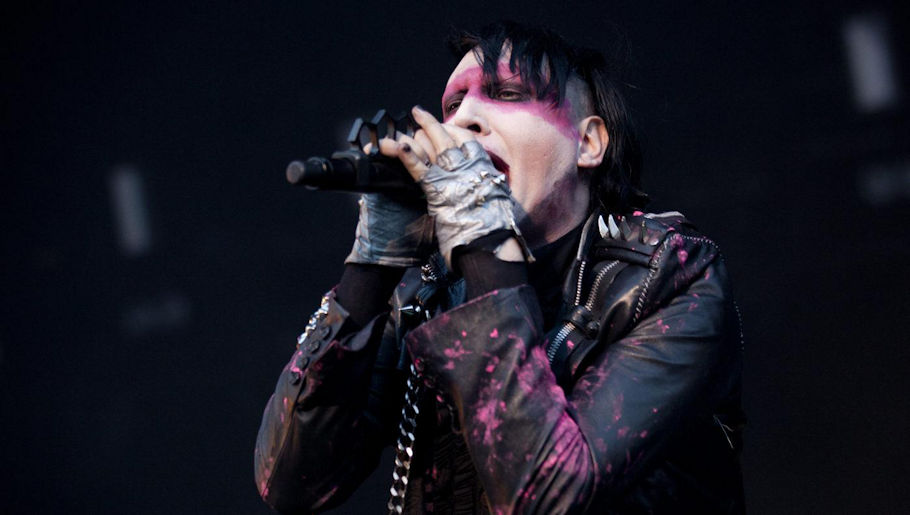 A close-up photograph of Marilyn Manson performing live onstage, holding a black microphone with both hands as he sings. He has pale white makeup, dark eye makeup, and black hair styled in messy, uneven strands falling across his forehead. His mouth is open as he sings, and his intense expression conveys aggression and theatrical energy. He wears a distressed black leather jacket decorated with silver spikes, metal studs, zippers, and splashes of pink paint. His hands are wrapped in worn, metallic silver fabric or bandages, with black sleeves extending underneath. A heavy silver chain hangs across his chest. Dramatic stage lighting casts pink and purple highlights across his face and clothing, while the background remains dark and indistinct, keeping the focus on his dramatic appearance and energetic performance.
Marilyn Manson did not become a cultural threat because he invented something particularly frightening. American culture already possessed an extensive vocabulary of violence, religious terror, sexual repression, celebrity worship, and public humiliation. What Brian Hugh Warner understood was that these elements could be assembled into a single recognizable identity and presented back to society as its own grotesque reflection. The resulting character was neither an ordinary rock musician nor simply a theatrical villain. He became a manufactured cultural enemy whose commercial existence depended on the institutions that condemned him.
The name contained the entire proposition. Marilyn Monroe represented an American fantasy of beauty, femininity, desirability, and industrially manufactured celebrity. Charles Manson represented murder, collective paranoia, and the terrifying possibility that charismatic influence could escape conventional social control. Combining their names created a symbolic collision between sexual attraction and moral revulsion. The resulting identity was simultaneously seductive and repellent, familiar and unacceptable, commercially accessible and apparently dangerous.
The distinction matters because Manson's provocation was never merely an accumulation of offensive images. It was a system of contradictions designed to make conventional classification difficult. Religious conservatives could identify blasphemy, parents could identify sexual danger, journalists could identify sensationalism, and alienated adolescents could identify an alternative to respectable American life. Each group encountered a different version of the same character. Their reactions collectively enlarged his cultural presence.
Manson's visual identity transformed the male rock star into something difficult to categorize. His pale skin, exaggerated makeup, artificial eyes, exposed flesh, distorted proportions, and deliberately uncomfortable gestures rejected the conventional masculinity associated with hard rock. He borrowed from gothic theatre, glam rock, horror cinema, fetish imagery, and the visual language of bodily deterioration. The resulting figure could appear feminine, predatory, vulnerable, mechanical, or almost inhuman depending on the photograph, performance, or album cycle. His body became an unstable surface onto which audiences projected their own anxieties.
Sexual ambiguity was essential to that construction. Manson repeatedly used androgyny, feminine clothing, eroticized religious imagery, and the suggestion of sexual practices outside conventional norms to destabilize expectations of male identity. His public image was not built around a clearly established asexual identity, and interpreting it as a declaration of his actual sexual orientation would confuse performance with personal biography. What sometimes appeared almost asexual was the removal of recognizable sexual categories: the character could be intensely erotic without presenting himself as conventionally desirable. Sexuality functioned less as a promise of intimacy than as an instrument of estrangement.
This made his appearance particularly effective in the cultural environment of the 1990s. Traditional rock masculinity had already been challenged by glam, punk, and alternative music, but Manson introduced a colder and more hostile variation. His sexuality was rarely reassuring, romantic, or even consistently pleasurable. It suggested domination, artificiality, contamination, and the transformation of the body into an object. The audience was not simply invited to desire him or reject him. It was forced to examine why certain bodies and sexual signals produced attraction while others produced disgust.
His visual language also exposed a contradiction within commercial entertainment. The same American culture that sold sexualized bodies through advertising, cinema, fashion, and television reacted with alarm when Manson reorganized those signals into disturbing configurations. He did not introduce sexuality into an otherwise innocent public sphere. He removed its reassuring packaging, combining beauty with disease, glamour with mutilation, and seduction with religious hostility. The resulting scandal revealed how much public tolerance depended on presentation rather than content.
Reducing Marilyn Manson to theatrical shock rock obscures one of the strongest components of the project: the extraordinary density and precision of the band's arrangements during its defining periods. The music was not simply loud guitar accompaniment for an elaborate visual performance. Its most successful recordings combined industrial programming, metallic percussion, distorted bass, layered guitars, unsettling electronic textures, and carefully controlled changes in dynamic intensity. Silence, repetition, mechanical rhythm, and melodic release were used as structural elements rather than decorative effects. The sound frequently created the sensation of entering an enclosed, unstable environment.
Antichrist Superstar, released in 1996, remains the clearest demonstration of that architecture. The album's abrasive surfaces conceal a carefully organized progression between claustrophobic passages, violent rhythmic assaults, and enormous theatrical climaxes. Songs such as "The Beautiful People" operate through disciplined repetition, while "Tourniquet" develops a more oppressive, almost ritualistic atmosphere. "The Reflecting God" expands the sound into something approaching industrial apocalypse. These arrangements gave the character a physical environment in which to exist, turning individual songs into connected episodes of a larger transformation.
The connection with Trent Reznor was decisive. Reznor, the creative force behind Nine Inch Nails, signed Manson's group to his Nothing Records label and played a major production role in Antichrist Superstar alongside Dave Ogilvie and a wider team of engineers and programmers. His involvement helped integrate the band's theatrical aggression with the sonic complexity of industrial rock. Yet attributing the album's entire achievement to Reznor would erase the contributions of Manson, Twiggy Ramirez, Madonna Wayne Gacy, Ginger Fish, and the production collaborators responsible for its distinctive musical construction. The result emerged from a collision of personalities and disciplines rather than from a single author.
The relationship also exposed the difference between influence and dependence. Reznor supplied important production expertise and access to an industrial vocabulary already developed through Nine Inch Nails, while Manson brought a more explicitly theatrical, symbolic, and media-oriented conception of rock performance. Their collaboration was productive precisely because the two artistic systems were not identical. Subsequent tensions and their eventual professional separation demonstrated that the partnership had its limits. But the recordings preserved the evidence of an unusually effective convergence between musical engineering and visual mythology.
Mechanical Animals in 1998 proved that the project could survive a substantial transformation of its musical language. Working without Reznor, Manson and his collaborators moved toward glam rock, expansive melodies, polished guitars, synthesizers, and a more emotionally exposed vocal approach. Producer Michael Beinhorn helped shape an album whose arrangements often possessed an almost cinematic sense of scale. The transition was not a retreat from darkness but a change in its presentation. Alienation became glamorous, melancholy became melodic, and the monster acquired the appearance of a manufactured pop idol.
This musical evolution matters because the image alone could not have sustained the project for decades. Provocation can attract attention, but a recognizable catalogue requires compositions capable of surviving outside the immediate controversy surrounding their release. "Coma White," "The Dope Show," and "Great Big White World" demonstrated that Manson's musical identity could accommodate atmosphere, vulnerability, and conventional songwriting without surrendering its unsettling character. The best work did not merely illustrate the persona. It gave that persona emotional and structural depth.
The commercial breakthrough of Antichrist Superstar, which reached number three on the Billboard 200, occurred in a country already preoccupied with youth violence, religious morality, censorship, and the perceived corruption of popular culture. Manson entered that environment with a character almost perfectly designed to provoke institutional resistance. Religious organizations protested concerts, political figures condemned his performances, and parents were warned about the supposed dangers of his music. These reactions became part of the public narrative surrounding the band. Opposition functioned as an additional distribution mechanism.
The process was particularly effective because Manson's artistic identity already anticipated the accusations. Being described as satanic, sexually corrupting, or socially dangerous did not necessarily contradict his public image. Such descriptions often confirmed what his audience believed he represented. Every denunciation could become another demonstration of his ability to disturb established authority. The controversy was therefore not external to the commercial system. It became one of its recurring sources of energy.
There was, however, a fundamental asymmetry in this confrontation. Religious and political critics often treated the stage character as a direct expression of personal belief and intention, while Manson could operate through theatrical ambiguity, satire, exaggeration, and symbolic inversion. He did not need every audience member to understand the work in the same way. In fact, contradictory interpretations frequently increased its reach. The character was most powerful when different groups believed they had discovered its definitive meaning.
The Columbine High School massacre in April 1999 transformed that conflict into something considerably more serious. In the immediate aftermath, parts of the media and political establishment connected Manson's music to the perpetrators, despite the absence of a credible causal foundation for the accusation. The association placed an artist already marketed as dangerous inside a national tragedy involving murdered students and profound collective grief. His established imagery made him an easily recognizable target. A complex failure involving violence, social conditions, and access to weapons could be compressed into a familiar cultural villain.
Manson responded in a 1999 Rolling Stone essay, "Columbine: Whose Fault Is It?", challenging the impulse to assign responsibility to entertainment while avoiding more difficult questions about American society. His appearance in Michael Moore's documentary Bowling for Columbine subsequently presented a markedly different figure from the one familiar through concert footage and sensational television coverage. Calm, articulate, and attentive to the social mechanisms surrounding the tragedy, he demonstrated an ability to analyze the same culture that had turned him into a scapegoat. The contrast was striking because the interview did not require him to abandon his artistic identity. It revealed the intelligence operating behind its construction.
Columbine also exposed the limits of the argument that disturbing art produces disturbing behavior. An aesthetic can represent violence without instructing an audience to commit it, just as an artist's deliberately monstrous character does not establish responsibility for crimes committed by unrelated individuals. This distinction is not a declaration that culture has no influence. It is a demand that influence be demonstrated rather than inferred from clothing, musical preference, or offensive symbolism. In Manson's case, the public accusation revealed considerably more about the mechanisms of moral panic than about the actual causes of the massacre.
The allegations of sexual and psychological abuse that became public in 2021 created a fundamentally different crisis. Actress Evan Rachel Wood identified Manson, her former partner, as an alleged abuser, and other women subsequently made serious accusations concerning his conduct. Manson denied allegations of nonconsensual abuse. The resulting controversy led to his separation from Loma Vista Recordings, the loss of television opportunities, and multiple civil proceedings. Unlike the earlier disputes over religious symbolism or artistic influence, these accusations concerned alleged harm to identifiable individuals.
That distinction cannot be dissolved through the language of artistic provocation. A performance involving domination, sexual violence, or psychological cruelty may be interpreted as theatre, criticism, fantasy, or deliberate transgression. Allegations that such conduct occurred without consent in actual relationships concern a different category of responsibility. The stage persona cannot establish guilt, but neither can its theatrical character provide an automatic defense. The relevant questions concern evidence, consent, conduct, and the legal rights of everyone involved.
In January 2025, Los Angeles County prosecutors announced that they would not file criminal charges following a multiyear investigation. They explained that domestic violence allegations fell outside applicable limitation periods and that sexual assault charges could not be proved beyond a reasonable doubt. The decision was not a judicial finding that every allegation was false. Separately, civil litigation continued to produce different procedural outcomes, including the reinstatement in January 2026 of former assistant Ashley Walters's lawsuit under a new California law. Manson continued to deny wrongdoing.
The comparison with Columbine is revealing. In 1999, Manson was accused of influencing the violence of others, an accusation that could be incorporated into a public identity already associated with cultural danger. In 2021, he faced allegations concerning his own conduct, which could not be resolved by referring to censorship, moral panic, or artistic freedom. The first controversy largely reinforced the conflict on which his career had been built. The second challenged the boundary between the constructed monster and the private individual.
Manson's return to recording and touring, including the release of One Assassination Under God - Chapter 1 in 2024, demonstrated that the commercial and cultural consequences of controversy do not always produce permanent exclusion. His audience had not disappeared, and his visual language remained immediately recognizable. Yet the circumstances surrounding his return differed from those of the 1990s. The public discussion was no longer limited to whether offensive art should be permitted. It also involved questions about accountability, unresolved allegations, and the responsibilities of institutions choosing to work with contested performers.
His durability reflects the strength of an artistic identity constructed over decades. The name, typography, makeup, musical atmosphere, religious symbolism, and theatrical vocabulary remain connected even when individual albums, collaborators, and public circumstances change. Few rock performers have created such a consistent visual and conceptual territory. Its coherence has allowed the character to move between industrial metal, glam rock, gothic theatricality, and more restrained later recordings without becoming unrecognizable.
But coherence is not innocence, and cultural importance is not moral immunity.
Marilyn Manson's lasting significance lies in the uncomfortable relationship between what American culture publicly condemns and what it repeatedly consumes. His career developed through the commercialization of blasphemy, sexual uncertainty, artificial beauty, physical corruption, and institutional fear. He transformed social rejection into recognizable artistic material and demonstrated how effectively an enemy can be manufactured through the combined efforts of the performer, the audience, the media, and the institutions opposing him. The monster was never created by one person alone.
His strongest recordings also prevent the story from being reduced to publicity. Behind the grotesque imagery stood musicians and producers capable of building unusually powerful arrangements, connecting industrial aggression with theatrical scale and genuine melodic sophistication. That musical achievement remains independently assessable, regardless of the controversies surrounding the individual at the center of the project. It is possible to recognize the sophistication of the work without treating its creator as beyond criticism. It is equally possible to examine serious allegations without rewriting the entire musical history as though the recordings had never possessed artistic value.
The central contradiction survives. Manson constructed a public identity around the deliberate violation of acceptable boundaries, but real human relationships are governed by boundaries that theatrical transgression cannot simply erase. His career therefore raises a question larger than whether society should tolerate disturbing art. It asks what happens when a culture becomes so accustomed to consuming a manufactured monster that it struggles to distinguish the freedoms of performance from the responsibilities of the person performing.
The image can survive almost anything. The individual cannot be judged by the image alone.
More about people who shaped culture, identity systems, and the development of society in my book Identity Systems: Personal Brands, Influence, and Thought Leadership.
Lexx Che is a System Builder and Narrative Architect with nearly 20 years of experience, author, independent journalist, and researcher with Ukrainian roots. His work spans more than 1,000 projects across strategy, design, technology, digital ecosystems, organizational transformation, identity, and decision architecture. He is the developer of the Anti-Coaching methodology and author of the Responsibility series and other books exploring uncertainty, power, communication, and human agency.
His research also extends into independent journalism, with articles published across international media. He is listed as a journalist and author in Muck Rack's global media-intelligence database, while his published work is represented in EBSCOhost's international research and bibliographic infrastructure.
The above information is from our Lexx Che's Column Publications that includes:
Marilyn Manson: The Architecture of Sex, Fear, and Manufactured Evil - Explore Marilyn Manson's shock rock, industrial metal, provocative image, cultural controversies, and the conflict between artistic freedom and accountability.
Marilyn Monroe: The Woman Who Became Sex Itself - Explore how Marilyn Monroe became an enduring sex symbol through Hollywood glamour, iconic performances, sexual imagery, and artistic independence today.
The Wasp Factory: Identity Built Inside a Machine - Analysis of Iain Banks's The Wasp Factory, exploring how paternal control of information shapes Frank's identity, body, rituals and the illusion of free choice.
Inside H. R. Giger's Alien: The Biomechanical Horror That Changed Film, Art and Design - Why H. R. Giger’s Alien still unsettles: an analysis of the biomechanical design language that merged flesh and machine and reshaped genre culture for decades.
• Female G-Spot Location with Pictures
How to find the female g-spot.
• Am I Gay? Questions to Ask
Think you may be gay or bisexual?
• Glossary of Sexuality Terms
Definitions of sexual terms & acronyms.
• LGBTQ+ Pride Flags and Symbols
Symbols of Identity and Inclusion.
• Colored Jelly Bracelet Meanings
Meanings of jelly sex bracelet colors.
• Average Penis Size Chart
Information on the human penis size.
• Submissions: Send us your coming events and LGBTQ related news stories.
• (APA): Lexx Che. (2026, November 10). Marilyn Manson: The Architecture of Sex, Fear, and Manufactured Evil. SexualDiversity.org. Retrieved November 10, 2026 from www.sexualdiversity.org/lexx/1226.php
• Permalink: <a href="https://www.sexualdiversity.org/lexx/1226.php">Marilyn Manson: The Architecture of Sex, Fear, and Manufactured Evil</a>