

Author: SexualDiversity.org
Author Contact: SexualDiversity.org
Published: 25th Nov 2026
Peer-Reviewed Publication: N/A
Additional References: Sexuality Publications
Summary: Learn how to ask someone's pronouns respectfully, keep sharing optional, avoid intrusive questions, and correct a slip briefly without making it about yourself.
Pronouns are words that stand in for nouns or noun phrases so a speaker or writer does not have to repeat the same name or term over and over. Personal pronouns such as I, you, he, she, it, we and they point to people or things. Possessive pronouns such as mine, yours and theirs show ownership. Reflexive pronouns such as myself and themselves refer back to the subject. Demonstrative pronouns such as this and those point to something specific, interrogative pronouns such as who and which ask questions, and relative pronouns such as that and whom link clauses together. In social and identity contexts, "pronouns" usually means the personal pronouns a person wants others to use when referring to them, such as she/her, he/him or they/them. Using the right ones is a basic sign of respect and inclusion, and it matters especially for transgender, nonbinary and gender-diverse people.
You are about to introduce someone at a community meeting. You know their name, but you are unsure which pronouns to use. Asking can be straightforward: find out how to refer to the person, give them room to decline, and leave their private history out of it.
This guide is for conversations among adults. The examples are hypothetical. It draws on published pronoun guidance, rather than personal testimony or clinical advice.
Pronouns such as she, he, and they are words we use when referring to someone. You cannot reliably choose a person's pronouns from their appearance. UMass Amherst recommends asking directly and describes pronoun sharing as an opportunity that should remain optional. [1]
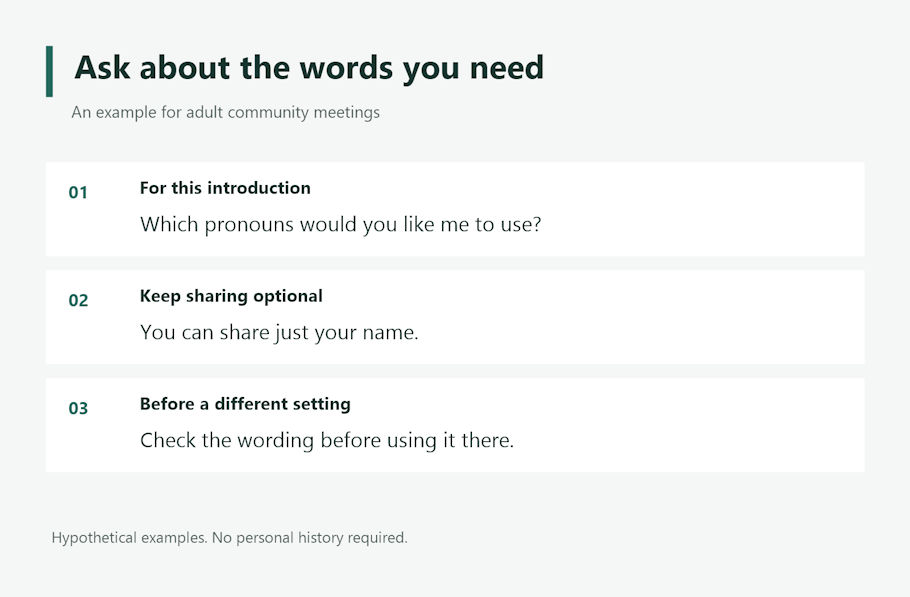
In a quiet moment before the meeting, you could ask, "Which pronouns would you like me to use in the introduction?" That question has a clear purpose. It does not ask the person to identify their gender, explain a transition, or tell you why a particular word fits.
If the answer is unfamiliar, ask only for the language you need: "Could you give me an example sentence?" Then use an educational resource to practice on your own. A brief introduction does not need to become an impromptu interview.
 A brief correction can return attention to the conversation.
Offering your own pronouns can open a conversation, but it does not create an obligation to respond. Pronouns.org describes asking as an invitation and advises against forcing disclosure. [2]
For a group introduction, a host might say, "Please share your name. You can add pronouns if you want to." Then move on just as naturally when someone gives only a name. Avoid following up in front of the group with a question about why that person skipped the optional part.
The practical test is what happens after someone declines. If the meeting stops while everyone waits for an explanation, the invitation was not very optional. Give people the same opportunity to participate, without making a particular person account for their choice.
A private conversation and a public introduction are different settings. Pronouns.org notes that the names or pronouns someone shares in one setting may differ in another. Its guidance on mistakes also asks readers to consider whether a person wants the same pronouns used in every context. [2, 3]
Before adding pronouns to a public event page or introducing someone to a different group, check the specific use: "Are these the pronouns you want in the speaker introduction, too?" If the person requests different wording there, follow that instruction without announcing the difference or explaining it to the room.
For an organizer, this is a reason to make the proposed wording easy to review. Send the short introduction itself, rather than asking someone to describe every part of their life where different language might apply. Let them correct the text you actually plan to use.
UMass Dartmouth's guidance separates respectful address from intrusive questions about a person's body, medical care, former name, or relationships. It advises against asking for private information irrelevant to the relationship unless the person invites that discussion. [4]
If someone says they use she/her, you have the information needed for the introduction. There is no missing explanatory step. Questions about surgery, an earlier name, or a partner's reaction do not help you write the next sentence.
Someone may choose to share more later. Listen to what they actually offer, and let them set the scope. A volunteered detail is not an invitation to work through a checklist of other personal questions.
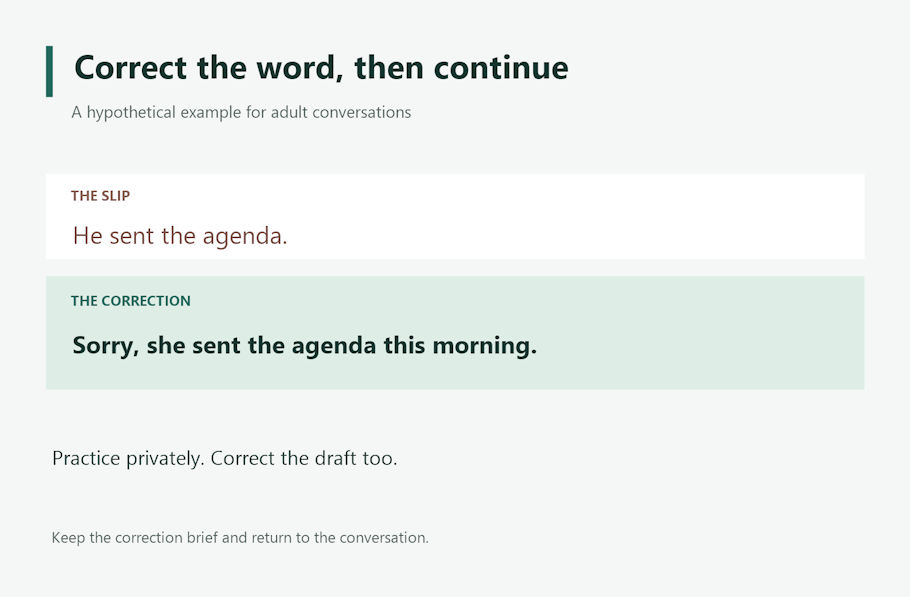
If you use the wrong pronoun, make a short correction and continue. Both Pronouns.org and UMass Dartmouth advise against turning a mistake into a prolonged moment centered on the speaker. [3, 4]
For example: "He sent the agenda. Sorry, she sent the agenda this morning." The correction supplies the right word and returns attention to the agenda. A long explanation of your intentions can instead leave the other person responding to your embarrassment.
Afterward, practice a few ordinary sentences privately. If the error is in an introduction you have drafted, correct the draft as well. The useful follow-through is a change in the language you use next time.
 Keep the question relevant to the introduction, and leave sharing optional.
There will be moments when asking is impractical or someone chooses not to answer. Victoria University suggests using the person's name when pronouns are unknown. [5] In the meeting example, you could say, "Alex sent the agenda; let's start with the first item."
That lets the conversation proceed without a guess or a demand for disclosure. If you need guidance for a later introduction, ask privately when there is a suitable opportunity. Keep the question tied to the words you need, and leave the rest of the person's story with them.
[1] UMass Amherst, "Pronoun Information."
https://www.umass.edu/student-life/pronoun-information
[2] Pronouns.org, "Asking Others Their Pronouns."
https://pronouns.org/asking
[3] Pronouns.org, "Mistakes."
https://pronouns.org/mistakes
[4] UMass Dartmouth, "Trans Inclusivity."
https://www.umassd.edu/cwgs/trans-inclusivity/
[5] Victoria University, "Share, ask & learn: A guide to getting pronouns right."
https://www.vu.edu.au/about-vu/news-events/vu-blog/share-ask-learn-a-guide-to-getting-pronouns-right
The above information is from our Sexuality Publications that includes:
Asking About Pronouns Without Asking for a Personal History - Learn how to ask someone's pronouns respectfully, keep sharing optional, avoid intrusive questions, and correct a slip briefly without making it about yourself.
Jim Morrison, the Last Damned Poet — Sex, Death and the Lizard King - Jim Morrison as poet, not poster: The Lords, Horse Latitudes, the 1969 Miami trial, Pamela Courson, Patricia Kennealy and his early 1971 death in Paris.
The Hidden Cost of Sexual Shame: Why People Struggle to Talk About Desire - Explore how sexual shame silences questions about desire, why privacy differs from shame, and how judgment-free conversations separate difference from disorder.
Marilyn Monroe: The Woman Who Became Sex Itself - Explore how Marilyn Monroe became an enduring sex symbol through Hollywood glamour, iconic performances, sexual imagery, and artistic independence today.
• Female G-Spot Location with Pictures
How to find the female g-spot.
• Am I Gay? Questions to Ask
Think you may be gay or bisexual?
• Glossary of Sexuality Terms
Definitions of sexual terms & acronyms.
• LGBTQ+ Pride Flags and Symbols
Symbols of Identity and Inclusion.
• Colored Jelly Bracelet Meanings
Meanings of jelly sex bracelet colors.
• Average Penis Size Chart
Information on the human penis size.
• Submissions: Send us your coming events and LGBTQ related news stories.
• (APA): SexualDiversity.org. (2026, November 25). Asking About Pronouns Without Asking for a Personal History. SexualDiversity.org. Retrieved November 25, 2026 from www.sexualdiversity.org/sexuality/1234.php
• Permalink: <a href="https://www.sexualdiversity.org/sexuality/1234.php">Asking About Pronouns Without Asking for a Personal History</a>